Harley is doing great! I was concerned that he would go back to fighting contact, tossing his head, and other habits from the past, but he has surprised me. He is keeping rein contact at the walk and trot, through transitions, and even from halt to walk. He will occasionally toss his head for a few seconds in walk to trot transitions, but then drops his head and accepts contact without a fuss. He seems to especially enjoy the leg yield exercises we do, when he isn't tripping over his own feet because he is rushing. The key to these exercises is to go very, very slow so that each step is deliberate and he can organize his feet properly and perform the exercise correctly. Harley has a tendency to anticipate and will often try to do what he thinks I'm going to ask next, and he gets it right about half of the time. Slow and steady is the key to keeping him relaxed and focused.
It still works like magic to bend, turn, change direction when he begins to get anxious or distracted. We will continue to work on bending right, which was difficult for him in the past, but has improved a lot with bending exercises, and with the help of his chiropractor, Dr. Jenny Johnson. He received the best report ever after his last treatment, with the issues in his poll and neck dramatically improved. He is now almost straight tracking right, but we will continue to do the exercises to support his development and keep those left side muscles long and supple. We are also walking over ground poles, and a few days ago, Harley walked calmly over 3 poles without touching any of them. Good boy, Harley!!
Sunday, May 29, 2011
Saturday, April 9, 2011
Back to Basics
Now that I once more have a saddle that fits Harley, we have had to return to the beginning of the Training Scale (Relaxation, Rhythm, Contact, Impulsion, Straightness, Collection). It was necessary to work on Relaxation again, as he had become tense in anticipation of pain from the saddle, which also probably brought back frightening memories from his abusive past. To help him relax, I did very little ring work, and just rode around on the trails and paths on a fairly loose rein, with little or no trotting. You cannot make bad memories just disappear, you have to replace them with good memories, and a calm, simple trail ride can do just that. And I talk to him constantly, telling him how good and brave he is, and he really responds to my voice, and to a gentle stroke of his neck.
Then, when I did ride him in a ring, it was in a very calm, relaxed manner, staying soft on his mouth, talking to him, and doing small exercises such as loops down the long side, a few serpentines, even some figure 8's. My trainer, Jane Armour, explained to me that the best thing to do when a horse gets distracted or is looking for a reason to get excited or spook, is to keep him moving forward and give him something to do, such as turn or change direction. This works beautifully with Harley. By keeping him "busy" he forgets to look around, concentrates on what I've asked him to do, and then relaxes in spite of himself.
Because of Harley's past, he wil lalways have "flashbacks" to the abuse and mistreatment, but over time, these moments will become fewer and farther between as he learns to deal with situations calmly and choose to move forward and past the fear.
A very relaxed, slightly chubby, but happy Harley standing ground-tied....

Then, when I did ride him in a ring, it was in a very calm, relaxed manner, staying soft on his mouth, talking to him, and doing small exercises such as loops down the long side, a few serpentines, even some figure 8's. My trainer, Jane Armour, explained to me that the best thing to do when a horse gets distracted or is looking for a reason to get excited or spook, is to keep him moving forward and give him something to do, such as turn or change direction. This works beautifully with Harley. By keeping him "busy" he forgets to look around, concentrates on what I've asked him to do, and then relaxes in spite of himself.
Because of Harley's past, he wil lalways have "flashbacks" to the abuse and mistreatment, but over time, these moments will become fewer and farther between as he learns to deal with situations calmly and choose to move forward and past the fear.
A very relaxed, slightly chubby, but happy Harley standing ground-tied....


Friday, March 25, 2011
A Saddle That Fits
The GFS saddle arrived, and Harley is showing no signs of any discomfort from it. The new saddle, a fleece shaped pad, and a nice, soft Stubben girth seem to be a winning combination. Of course, now the weather has gone bad and we have had more rain, but I'm still riding when the sun comes out. We haven't been able to school in a ring very much, but the weather will improve and we'll be able to.
I know now to check my saddle fit every few months, and to watch Harley for signs that there are pressure points. Checking the sweat pattern on his back after every ride will also become a regular habit, as that can show if the saddle is sitting evenly on him. The Elite fit Harley with the gullet plate that came with it, but to be on the safe side, I also ordered extra plates that are wider and narrower in case his body changes. Fingers crossed that, if that happens, one of the plates will make the necessary adjustment.
 What does Harley think of his new saddle? Is this a happy horse?
I know now to check my saddle fit every few months, and to watch Harley for signs that there are pressure points. Checking the sweat pattern on his back after every ride will also become a regular habit, as that can show if the saddle is sitting evenly on him. The Elite fit Harley with the gullet plate that came with it, but to be on the safe side, I also ordered extra plates that are wider and narrower in case his body changes. Fingers crossed that, if that happens, one of the plates will make the necessary adjustment.
 What does Harley think of his new saddle? Is this a happy horse?
Wednesday, March 9, 2011
Saddle Fitting - Trial and Error
After riding Harley in the Schleese for about a month now, I'm not convinced that he is completely happy with it. Although it fits him very well, no bridging, wide enough gullet, and not too long in the tree, the design of the saddle may not work for him. Harley is very sensitive about pressure in the withers/shoulder area, and the design of the front panels might be an issue.
However, while searching online for information about this problem, I discovered that the company that makes my previous saddle, also makes a line of saddles for horses with wide withers and shoulders. After shopping around, I found a merchant who was selling a model very similar to my first saddle, and they offer 7 different gullet plates to "custom" fit the saddle to the horse. I've ordered the saddle with 4 extra gullet plates, and am optimistic that one of them will fit him comfortably.
If one of these plates does not work on Harley, I may just get a western saddle and turn him into a warmblood trail horse. No, not really, but as you can tell, owning a horse can be a very frustrating, patience-testing experience. Be prepared to endure trials and tribulations, and never give up on your horse. Other people gave up on Harley, and I will not. He's so very special, and deserves to have someone believe in him and stick with him no matter what.
However, while searching online for information about this problem, I discovered that the company that makes my previous saddle, also makes a line of saddles for horses with wide withers and shoulders. After shopping around, I found a merchant who was selling a model very similar to my first saddle, and they offer 7 different gullet plates to "custom" fit the saddle to the horse. I've ordered the saddle with 4 extra gullet plates, and am optimistic that one of them will fit him comfortably.
If one of these plates does not work on Harley, I may just get a western saddle and turn him into a warmblood trail horse. No, not really, but as you can tell, owning a horse can be a very frustrating, patience-testing experience. Be prepared to endure trials and tribulations, and never give up on your horse. Other people gave up on Harley, and I will not. He's so very special, and deserves to have someone believe in him and stick with him no matter what.
Wednesday, February 9, 2011
Saddle Fitting - The Sequel
As it turns out, my "adjustable gullet" saddle can not be adjusted enough to properly fit Harley. He has developed so much muscle in his shoulders, that the gullet plates do not go wide enough to accommodate him. The Schleese saddle fitter gave me a dressage saddle to ride on trial, and it fits Harley perfectly. Unfortunately, it does not work for me, as I plan to jump Harley and need a General Purpose/Jumping saddle.

My trainer and I visited a local tack store, and they had a Schleese GP/Jumping saddle on consignment. It is the tree width and seat size that I need. It also has a "Flair" system, which means the panels have air bags in them which can be inflated/deflated to fit the horse. I have heard that these can leak, and the saddle fitter said she can remove the air bags and replace them with wool flocking, which is what I plan to do. In the meantime, I am using the saddle with a thick pad to protect Harley's back, and he seems okay with it. But I'm not quite convinced, and I'm not sure Harley is either.

If you have never had your saddle fitted by your trainer or an expert, I highly recommend that you do so. It is not true that adding saddle pads or shims will make a saddle fit correctly in all cases. Don't find out the hard way, like I did, by being bucked off, that your saddle is hurting your horse's back. A correctly fitting saddle can also correct behavior and performance problems. But always have your horse looked at by your vet first, if you suspect it is reacting to pain of any kind.
We'll let you know what happens with the Schleese.....
Saturday, January 29, 2011
Does Your Saddle Truly Fit Your Horse?
Over the past few weeks, I've learned more about saddle fitting than I ever imagined. There are as many views about saddle fitting as there are riders. One thing I know with absolute certainty, is that a saddle does not fit properly makes for a very unhappy horse, and understandably so. Harley had put on muscle in his shoulders from all the riding and schooling we had done, and I had no idea it changed the fit of his saddle. Here is a photo of how my saddle flares out at the bottom front panel, so that when I tighten the girth and the panel is pulled down against his shoulder, the top pinches into his withers.
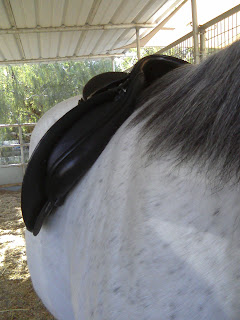 I have a professional saddle fitter coming out to see if my saddle can be altered to correctly fit Harley. I am hoping it can be done, but if not, I will definitely invest in a saddle that fits him perfectly.
 I have a professional saddle fitter coming out to see if my saddle can be altered to correctly fit Harley. I am hoping it can be done, but if not, I will definitely invest in a saddle that fits him perfectly.
 Fortunately, my saddle has a Gullet Exchange System, which means that different width gullet plates can be put in the saddle to make the tree wider or narrower as needed. When I bought my saddle, I also bought the 2 next wider gullet plates, with the idea that schooling and training would bulk him up. There are no guarantees that a wider plate will make the saddle fit him, as the angle of the plate also has to be correct, but I remain optomistic.

The photo to the right is my trainer's saddle; it fits him much better and conforms to the slope of his shoulder.
Will let everyone know how the fitting turns out. Meanwhile, I have a much happier horse now that I am using a saddle that does not pinch. Harley and I are working on coming back to strength and fitness gradually and carefully. Soon we will be back to schooling, and hopefully doing ground poles soon on our way to jumping.
Equine Chiropractic Treatments
The last month or so has been relatively unproductive, due in large part to the southern California area receiving record rains and cold weather. However, Harley and I have made a huge breakthrough, not in our riding, but in his physical and mental well-being. I have known since I bought him that he was very protective of his right side, always turning to look at me even when I just combed his mane. Over the past couple of months, Harley had become more and more girthy, pinning his ears when the saddle was placed on his back, and fussing a lot when the girth was tightened.
Everything came to a head a couple of weeks ago when I rode Harley, and noticed he seemed very tense, not his usual happy self, and I just knew something was wrong. Then, while trotting across the ring, Harley put his head down and bucked me off. He had never bucked while I was riding him before. He continued to buck all the way to the gate. My trainer told me he was literally standing on his head and twisting his back end sideways. Fortunately, I was not hurt, just had the wind knocked out of me and a bit sore. After turning Harley loose in the round pen to buck a few more times, and replacing the set of reins he had broken, I got back on him. He still felt very tense, so I only rode him for a few minutes. The next day, he had a very sore shoulder so I did not ride him. Over the next week or so, I noticed that Harley seemed depressed, stayed at the back of his stall and did not come to the gate to greet me. Finally, after about a week, he perked up a little, and seemed to enjoy taking walks, but something just wasn't right.
I decided to call an equine chiropractor, Dr. Jenny Johnson, V.M.D. She was recommended by my vet, so I made an appointment. Dr. Johnson came out and first watched Harley walk and trot away from and towards her. Then she did a preliminary examination, feeling all of his joints, his spine, and skull. She found several misalignments in his vertebrae, and also his withers, a hip, and an elbow. The most "out of whack" area was at the very top of his neck, behind his ears.
Dr. Johnson proceeded to adjust Harley, and he was surprisingly good about it. After the first few minutes, I could tell that he knew she was helping him. He was so relaxed when she finished that he wouldn't move, just stood in his stall with his ears up looking happier than I had seen him in weeks. Dr. Johnson also looked at Harley's saddle on his back, and informed me that it was not fitting him properly, flaring out at the front of the flap and digging into his wither/shoulder area when the girth was tightened, especially on his right side. He has more muscle there now than when I first got my saddle. That explained the sensitivity on that side of his body. We made an appointment for her to come back in 3 weeks, and she left us with instructions to hand walk only for 2-3 days, and exercises to bend his head, without moving his neck, to loosen up the poll area. From the day of his appointment on, he has been a new horse, walking out freely, loose and relaxed, and his old happy personality was back!
Yesterday was day 4, and I rode Harley bareback. I could not believe how relaxed and calm he was, how loose he felt, how big his stride was. It was like having a brand new horse. My trainer noticed right away how relaxed he looked and how much bigger his walk was. I rode him again today, still bareback, and he was even better. I have to have my saddle flocked to fit him, but fortunately, Jane's saddle fits him perfectly and she has graciously agreed to let me use it until mine is corrected.
Vet exams in the past had revealed no injuries so no treatment was prescribed, and several massage sessions had not made any noticeable difference. I was told he was tight in his shoulders and back, which was obvious, but the cause was never addressed. I think massage is a temporary "bandaid" that relaxes the horse for a little while but does not deal with the root problem, so the muscles tighten up again and more massage is needed, sort of a never-ending cycle that doesn't fix the problem. Chiropractic treatment actually addresses the problem, works to fix it, and prevents the problems from becoming chronic. I would consider massage as a supplement to the chiropractic sessions, but only by an experienced equine massage therapist recommended by my vet and the chiropractor.
I would strongly recommend anyone considering equine chiropractic and/or massage to have your horse examined by your vet first to rule out injury or illness. Dr. Johnson would not work on Harley until I had spoken to my vet first. I am very happy to have found a chiropractor for Harley who not only was recommended by my vet, but who will work with them as a team.
Visit Dr. Johnson's website at http://www.equineshockwave.com/vetchiropractic.html
Everything came to a head a couple of weeks ago when I rode Harley, and noticed he seemed very tense, not his usual happy self, and I just knew something was wrong. Then, while trotting across the ring, Harley put his head down and bucked me off. He had never bucked while I was riding him before. He continued to buck all the way to the gate. My trainer told me he was literally standing on his head and twisting his back end sideways. Fortunately, I was not hurt, just had the wind knocked out of me and a bit sore. After turning Harley loose in the round pen to buck a few more times, and replacing the set of reins he had broken, I got back on him. He still felt very tense, so I only rode him for a few minutes. The next day, he had a very sore shoulder so I did not ride him. Over the next week or so, I noticed that Harley seemed depressed, stayed at the back of his stall and did not come to the gate to greet me. Finally, after about a week, he perked up a little, and seemed to enjoy taking walks, but something just wasn't right.
I decided to call an equine chiropractor, Dr. Jenny Johnson, V.M.D. She was recommended by my vet, so I made an appointment. Dr. Johnson came out and first watched Harley walk and trot away from and towards her. Then she did a preliminary examination, feeling all of his joints, his spine, and skull. She found several misalignments in his vertebrae, and also his withers, a hip, and an elbow. The most "out of whack" area was at the very top of his neck, behind his ears.
Dr. Johnson proceeded to adjust Harley, and he was surprisingly good about it. After the first few minutes, I could tell that he knew she was helping him. He was so relaxed when she finished that he wouldn't move, just stood in his stall with his ears up looking happier than I had seen him in weeks. Dr. Johnson also looked at Harley's saddle on his back, and informed me that it was not fitting him properly, flaring out at the front of the flap and digging into his wither/shoulder area when the girth was tightened, especially on his right side. He has more muscle there now than when I first got my saddle. That explained the sensitivity on that side of his body. We made an appointment for her to come back in 3 weeks, and she left us with instructions to hand walk only for 2-3 days, and exercises to bend his head, without moving his neck, to loosen up the poll area. From the day of his appointment on, he has been a new horse, walking out freely, loose and relaxed, and his old happy personality was back!
 |
| So relaxed, his ankles are crossed! |
Yesterday was day 4, and I rode Harley bareback. I could not believe how relaxed and calm he was, how loose he felt, how big his stride was. It was like having a brand new horse. My trainer noticed right away how relaxed he looked and how much bigger his walk was. I rode him again today, still bareback, and he was even better. I have to have my saddle flocked to fit him, but fortunately, Jane's saddle fits him perfectly and she has graciously agreed to let me use it until mine is corrected.
Vet exams in the past had revealed no injuries so no treatment was prescribed, and several massage sessions had not made any noticeable difference. I was told he was tight in his shoulders and back, which was obvious, but the cause was never addressed. I think massage is a temporary "bandaid" that relaxes the horse for a little while but does not deal with the root problem, so the muscles tighten up again and more massage is needed, sort of a never-ending cycle that doesn't fix the problem. Chiropractic treatment actually addresses the problem, works to fix it, and prevents the problems from becoming chronic. I would consider massage as a supplement to the chiropractic sessions, but only by an experienced equine massage therapist recommended by my vet and the chiropractor.
I would strongly recommend anyone considering equine chiropractic and/or massage to have your horse examined by your vet first to rule out injury or illness. Dr. Johnson would not work on Harley until I had spoken to my vet first. I am very happy to have found a chiropractor for Harley who not only was recommended by my vet, but who will work with them as a team.
Visit Dr. Johnson's website at http://www.equineshockwave.com/vetchiropractic.html
Subscribe to:
Posts (Atom)